The National Safety Commission Alerts
Safety is No Accident. Visit the National Safety Commission - America's Safety Headquarters for driver safety information, auto recalls and teen safe driver tips.
Friday, May 27, 2011
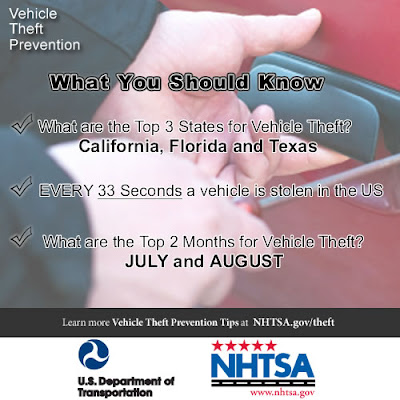
Not Gone in 33 Seconds: Vehicle Theft Prevention
Life without the ubiquitous car: unimaginable. Owning a car is a convenience. Every 33 seconds, that convenience is taken from a driver in the United States. Currently, the Department of Transportation's (DOT) National Highway Traffic Safety Administration (NHTSA) establishes implements and enforces vehicle antitheft regulations.
The short view of it is, losing a car means not being able to drive to the store, run errands, or go to a friend's house. The long view is, for other people, losing their means of transportation would cost them their livelihood.
Unlikely and Everywhere
In the movies, it always seems like the cars that would get stolen are the sports cars --- in that world, no one seems to take notice of the passenger car, or the kinds of cars everyone drives. This has created a false sense of security for a majority of car owners, thinking that their vehicles likely won't be targeted.
Which simply isn't true --- according to the FBI's 2008 Uniform Crime Rate Report, more than 72% of all motor vehicles reported stolen are passenger cars.
The problem isn't even isolated in any certain state. Truth is, it happens all over the country: in our backyards, garages and even in most parking lots. At times the thieves aren't even after the whole vehicle itself; sometimes they just take the parts which can be sold.
Fear not
Though it is true that anyone and any vehicle may be the target of vehicle theft, the NHTSA have released tips and methods to prevent you from becoming a victim. 40-50% of vehicle theft is due to driver error, which includes leaving vehicle doors unlocked and leaving keys in the ignition or on the seats. Preventing that is as simple as being careful and having a keychain!
Some more vehicle theft prevention tips are leaving visual deterrents, such as steering wheel, brake and wheel locks and not parking in secluded/sketchy places.
Always be vigilant. Be informed. NHTSA has put up a great resource for vehicle theft prevention on their site that is worth looking into.
Download Brochure: Vehicle Theft Information: What Consumers Should Know
The short view of it is, losing a car means not being able to drive to the store, run errands, or go to a friend's house. The long view is, for other people, losing their means of transportation would cost them their livelihood.
Unlikely and Everywhere
In the movies, it always seems like the cars that would get stolen are the sports cars --- in that world, no one seems to take notice of the passenger car, or the kinds of cars everyone drives. This has created a false sense of security for a majority of car owners, thinking that their vehicles likely won't be targeted.
Which simply isn't true --- according to the FBI's 2008 Uniform Crime Rate Report, more than 72% of all motor vehicles reported stolen are passenger cars.
The problem isn't even isolated in any certain state. Truth is, it happens all over the country: in our backyards, garages and even in most parking lots. At times the thieves aren't even after the whole vehicle itself; sometimes they just take the parts which can be sold.
Fear not
Though it is true that anyone and any vehicle may be the target of vehicle theft, the NHTSA have released tips and methods to prevent you from becoming a victim. 40-50% of vehicle theft is due to driver error, which includes leaving vehicle doors unlocked and leaving keys in the ignition or on the seats. Preventing that is as simple as being careful and having a keychain!
Some more vehicle theft prevention tips are leaving visual deterrents, such as steering wheel, brake and wheel locks and not parking in secluded/sketchy places.
Always be vigilant. Be informed. NHTSA has put up a great resource for vehicle theft prevention on their site that is worth looking into.
Download Brochure: Vehicle Theft Information: What Consumers Should Know
Labels: alert drivers, parking lot safety, vehicle theft prevention


Wednesday, December 01, 2010
One Third Of Drivers Killed In Collisions Had Drugs In Their System
A new study released by the National Highway Traffic Safety Administration (NHTSA) reveals that evidence of drug use in drivers has increased over the past five years. The study evaluated coroner reports on drivers who were fatally injured in car crashes in 2009 and compared the data to reports from previous years.
In 2009, 63% of drivers who were killed in crashes were tested for the presence of drugs in their system and in 8% of the cases the test results were ambiguous or unknown. That left 3,952 drivers or 33% with positive test results for drugs in their system. The results show that the number of drivers with positive test results for drugs has risen steadily from 28% in 2005 to 33% in 2009.
NHTSA was careful to point out that the evidence of drug use did not indicate whether or not the driver was impaired nor did it imply that the drug use caused the crash, only that drugs were present in the driver’s system.
The study looked for specific drug types including: "nar¬cotics, depressants, stimulants, hallucinogens, cannabinoids, phencyclidines (PCP), anabolic steroids, and inhalants." Alcohol and any drugs administered by medical personnel, prior to the driver's death, were not included in the study.
This study adds data to another NHTSA sponsored study conducted in 2007 in which drivers were stopped at random and asked to voluntarily provide blood and fluid samples. The results of that study showed that:
The 2007 survey also showed that, among those who showed evidence of illegal drugs in their system, there was also a higher incidence of alcohol use combined with those drugs.
Not all of the drugs tested are illegal. Stimulants and depressants are often prescribed by doctors for sleep disorders and psychological problems while steroids are prescribed for a variety of conditions. Narcotics are prescribed for chronic pain. The problems lie in the fact that drivers are often unaware that prescription and some over-the-counter, medications, primarily cold and allergy remedies, can impact their driving abilities.
Driver Education: Driving with a Cold or Flu
Some studies have also show that the prevalence of prescription marijuana laws in some states are leading many young people to believe that marijuana is a harmless drug and has little impact on their driving abilities when in fact, marijuana, just like alcohol, gives the user a false sense that their ability to drive or perform other complex tasks is greater than it actually is. Steroids and stimulants can make a driver nervous, edgy, and quick to anger which can lead to bad decisions and risky driving behavior.
States are having a hard time dealing with this issue and, in many cases, there are no specific laws to deal with a driver whose driving abilities may have been impaired by a legal prescription or over-the-counter medication. So, it is left up to the driver to ask their doctor or pharmacist what type of side effects a particular medication may have and how that medication may impact their driving abilities. Drivers who have a new medication prescribed to them should refrain from driving until they know exactly how that drug will affect them.
In 2009, 63% of drivers who were killed in crashes were tested for the presence of drugs in their system and in 8% of the cases the test results were ambiguous or unknown. That left 3,952 drivers or 33% with positive test results for drugs in their system. The results show that the number of drivers with positive test results for drugs has risen steadily from 28% in 2005 to 33% in 2009.
NHTSA was careful to point out that the evidence of drug use did not indicate whether or not the driver was impaired nor did it imply that the drug use caused the crash, only that drugs were present in the driver’s system.
The study looked for specific drug types including: "nar¬cotics, depressants, stimulants, hallucinogens, cannabinoids, phencyclidines (PCP), anabolic steroids, and inhalants." Alcohol and any drugs administered by medical personnel, prior to the driver's death, were not included in the study.
This study adds data to another NHTSA sponsored study conducted in 2007 in which drivers were stopped at random and asked to voluntarily provide blood and fluid samples. The results of that study showed that:
- 11% of daytime drivers were driving with some sort of drug in their system.
- 14.4% of night-time drivers were driving with some sort of drug in their system.
The 2007 survey also showed that, among those who showed evidence of illegal drugs in their system, there was also a higher incidence of alcohol use combined with those drugs.
Not all of the drugs tested are illegal. Stimulants and depressants are often prescribed by doctors for sleep disorders and psychological problems while steroids are prescribed for a variety of conditions. Narcotics are prescribed for chronic pain. The problems lie in the fact that drivers are often unaware that prescription and some over-the-counter, medications, primarily cold and allergy remedies, can impact their driving abilities.
Driver Education: Driving with a Cold or Flu
Some studies have also show that the prevalence of prescription marijuana laws in some states are leading many young people to believe that marijuana is a harmless drug and has little impact on their driving abilities when in fact, marijuana, just like alcohol, gives the user a false sense that their ability to drive or perform other complex tasks is greater than it actually is. Steroids and stimulants can make a driver nervous, edgy, and quick to anger which can lead to bad decisions and risky driving behavior.
States are having a hard time dealing with this issue and, in many cases, there are no specific laws to deal with a driver whose driving abilities may have been impaired by a legal prescription or over-the-counter medication. So, it is left up to the driver to ask their doctor or pharmacist what type of side effects a particular medication may have and how that medication may impact their driving abilities. Drivers who have a new medication prescribed to them should refrain from driving until they know exactly how that drug will affect them.
Labels: alert drivers, buzzed driving, over-the-counter medications, prescription drugs, prescription medication
Thursday, September 09, 2010
The Danger of Driving On Prescription and Over-the-Counter Drugs
Thanks to public education by anti-drunk driving campaigns, the percentage of drunk drivers on our nation’s highways has been dramatically reduced. However, a new, and just as dangerous, problem is emerging regarding drugged drivers. The problem is more extensive than one might realize because drivers are drug impaired not only on illegal drugs such as marijuana and cocaine but on prescription and common over-the-counter medications. The problem exists because many do not realize that their legally prescribed or over-the-counter medications can have a serious impact on their driving abilities.
In 2007, the National Highway Traffic Safety Administration (NHTSA) sponsored a study to gauge the amount of alcohol and drug use on US roads. In this survey, drivers were stopped at random and asked to voluntarily provide oral fluid and blood samples. The researchers were looking for the percentage of drivers who were driving with drugs that could negatively affect their driving abilities including:
The survey’s results show that:
The survey also showed that, among those who showed evidence of illegal drugs in their system, there was also a higher incidence of alcohol use combined with those drugs.
Legal Medications:
Four percent of drivers showed evidence of legal medications; both prescribed and over-the-counter. While low, that percentage shows that many drivers still don’t realize the effect that medications can have on their driving. Nor do they realize that they could possibly be arrested for DUI when driving under the influence of those medications alone.
Among those who tested positive for legal medications, 6.4% also tested positive for alcohol. That leads to additional problems because of the phenomenon known as “synergism” in which the effect of the alcohol can compound the drug’s effect or vice versa. For instance, something seemingly as harmless as taking aspirin, can, because of aspirin’s effect on the blood stream, allow the alcohol and its effects to reach the brain sooner.
Prescription medications:
A prescription drug's side effects can, in some cases, severely affect a driver’s abilities to safely operate a motor vehicle. Some commonly prescribed medications and their effects are:
Over-the-counter medications:
Any medication that includes warnings such as “May cause drowsiness” or “Do not operate machinery while taking this medication” should not be taken if you plan to drive. Consult with your doctor or pharmacist about any medication’s side effects and wait until you know how the drug is going to affect you before driving. Taking these drugs and driving could lead to a DUI or worse; injuring or killing someone in a drug impaired collision.
In 2007, the National Highway Traffic Safety Administration (NHTSA) sponsored a study to gauge the amount of alcohol and drug use on US roads. In this survey, drivers were stopped at random and asked to voluntarily provide oral fluid and blood samples. The researchers were looking for the percentage of drivers who were driving with drugs that could negatively affect their driving abilities including:
- alcohol level above the legal limitv
- any amount of alcohol in their system
- illegal drugs (controlled substances or illegally obtained prescription medications)
- medications (both prescribed and over-the-counter)
The survey’s results show that:
- 11% of daytime drivers were driving with some sort of drug in their system
- 14.4% of night-time drivers were driving with some sort of drug in their system.
The survey also showed that, among those who showed evidence of illegal drugs in their system, there was also a higher incidence of alcohol use combined with those drugs.
Legal Medications:
Four percent of drivers showed evidence of legal medications; both prescribed and over-the-counter. While low, that percentage shows that many drivers still don’t realize the effect that medications can have on their driving. Nor do they realize that they could possibly be arrested for DUI when driving under the influence of those medications alone.
Among those who tested positive for legal medications, 6.4% also tested positive for alcohol. That leads to additional problems because of the phenomenon known as “synergism” in which the effect of the alcohol can compound the drug’s effect or vice versa. For instance, something seemingly as harmless as taking aspirin, can, because of aspirin’s effect on the blood stream, allow the alcohol and its effects to reach the brain sooner.
Prescription medications:
A prescription drug's side effects can, in some cases, severely affect a driver’s abilities to safely operate a motor vehicle. Some commonly prescribed medications and their effects are:
- Anxiety, restlessness, dizziness, tremors, sleepiness, and fatigue
Anti-depressants (Prozac, Zoloft)– These drugs regulate mood but can also affect sleep and mental clarity. Common side effects can include;
- Sleep-related behaviors, memory lapses, and hallucinations including “sleep-driving”, driving while not fully awake with no memory of the event.
Sedatives or Sleep Aids (Ambien) – Sleep aids are prescribed to combat insomnia or lack of sleep. Common side effects can include;
- Neuropsychiatric symptoms including changes in behavior, hostility, agitation, depressed mood, and suicide-related events. There have been some reports of violent behavior directed towards others.
Stop Smoking Aids (Chantix) – Stop smoking aids are designed to help smokers break the addiction of nicotine. Common side effects can include;
Over-the-counter medications:
- Generation 1 - with diphenhydramine as the active ingredient
- Generation 2 (non-drowsy) – with fexofenadine as the active ingredient
Two different studies looking at the effects of these medications on drivers, compared with the effects of alcohol, found that those taking the “generation 1” antihistamines (Benadryl) performed worse than drivers who were legally drunk.
Common side effects can include; - Dizziness, drowsiness, excitability, headache, nervousness, and restlessness.
Antihistamines (Benadryl, Sudafed) – These medications are commonly taken to reduce the symptoms of colds or hay fever. Anti-histamines are divided into two groups:
- severe dizziness, anxiety, restless feeling, or nervousness, confusion, and hallucinations
Cough Medicine (Robitusin) – These medications are taken to reduce coughing can, in large amounts, have a negative effect; in fact, over the past several years, they have been used as a cheap and legal way to get high. Common side effects can include;
Any medication that includes warnings such as “May cause drowsiness” or “Do not operate machinery while taking this medication” should not be taken if you plan to drive. Consult with your doctor or pharmacist about any medication’s side effects and wait until you know how the drug is going to affect you before driving. Taking these drugs and driving could lead to a DUI or worse; injuring or killing someone in a drug impaired collision.
Labels: alert drivers, buzzed driving, distracted driving, over-the-counter medications, prescription medication
Tuesday, November 10, 2009
Aromatherapy and Facial Cues to Keep Drivers Awake

An auto manufacturer announced that they were developing a system to track facial cues that indicate that a driver may be falling asleep at the wheel and then use the car's air conditioning system to adjust the temperature and humidity to create an optimal environment to keep the driver awake. The system goes further using aromatherapy to give a blast of aromas designed to increase alertness in the driver. This is just one of several systems in the works to recognize and prevent drowsy driving.
Drowsy driving is a serious issue on America's highways. The National Highway Traffic Safety Administration (NHTSA) reports that, based on police reports there are an average of:
The NHTSA feels these figures fall short of the full amount because they depend on vehicle occupants reporting drowsy driving to the police as a cause factor in the crash.
Studies show that America is a sleep deprived nation with 37% of drivers reporting that they have nodded off or fallen asleep at the wheel, 29% of those within the previous year and 10% within the previous month. That means that up to 75 million drivers have nodded off or fallen asleep at the wheel within the previous month.
With figures like that, the need for some kind of system to alert drivers before they fall asleep becomes apparent however some proposed systems seem to show more promise than others. The system that uses aromatherapy to heighten alertness could have a couple of problems. The system uses a camera trained on the driver and facial recognition software to recognize when a driver starts to yawn. A joint study by the University of California at San Diego (UCSD) and Sabanci University in Turkey found that yawning was ineffective as a predictor because, as someone starts to fall asleep, they yawn less, not more.
Studies designed to measure the effectiveness of aromatherapy have shown that the effect of aromatherapy may be due more to the placebo effect rather than any actual physical effects; that is, the user expects the aroma to work and thus reports a positive effect. A recent study by the University of Ohio looked at the effectiveness of lemon and lavender oils to improve mood. The experiment's subjects were put under a mild stress and then were exposed to cotton balls soaked in lemon oil, lavender oil, and water as a control. Some subjects were "primed" by being told what odor to expect while others were not. The results showed that the subjects, when told what aroma to expect, reported an improved mood more often after they were exposed to the water soaked cotton balls than the ones soaked in lavender oil. Blood pressure and blood chemical tests taken before and after exposure, showed no significant change in blood pressure or mood elevating chemicals.
In a German study designed to test aromatherapy's ability to increase alertness subjects were given cognitive tests before and after exposure to aromatic oils. A control group was tested without exposure to the oils. The study showed no statistical difference between those exposed to aromas and the control group.
Other systems that are under development to detect drowsiness in a driver show a little more promise. The UCSD program looked beyond yawning as a predictor for drowsiness. This program looked at 45 different points on the face. The study found that there were many more facial cues such as raised eyebrows, as the subjects fought to keep their eyes open, increased eye blinking, and other cues. The facial recognition software is designed to recognize all of those facial cues to predict that a driver may be drowsy. Different facial cues, along with erratic steering inputs, seem to show the best promise as a predictor for drowsy driving.
Mercedes has spent ten years developing a system that uses multiple cues and then sounds an audible alarm along with a flashing coffee cup icon on the dashboard display to warn the driver that he or she may be falling asleep.
These systems show some promise in their ability to warn a driver but the danger in these systems come when drivers depend on the system to give adequate warning instead of getting plenty of rest before hitting the road. A number of technological advances have been developed to make driving safer but safety experts warn that drivers may tend to rely too heavily on the technology rather than their own responsibility to be rested, alert, and paying attention to the driving environment ahead and around them. No matter how good the technology, it is still the driver's responsibility to be in full control of the vehicle.
Labels: alert drivers, driver safety, drowsy driving, sleep

 Find us on Facebook