The National Safety Commission Alerts
Safety is No Accident. Visit the National Safety Commission - America's Safety Headquarters for driver safety information, auto recalls and teen safe driver tips.
Wednesday, August 01, 2012
State Farm Plans “Celebrate My Drive” Events For Teens In September
 In order to promote safer driving and better
training for teen drivers, State Farm Insurance is planning a "Celebrate My Drive" event at shopping malls and participating State
Farm offices nationwide on September 15, 2012. According to their website:
In order to promote safer driving and better
training for teen drivers, State Farm Insurance is planning a "Celebrate My Drive" event at shopping malls and participating State
Farm offices nationwide on September 15, 2012. According to their website:- Have fun and win prizes
- Learn about safe driving in a celebratory way
- Help their school compete for a $100,000 grant
- Join other teens online to share experiences, receive support and have fun on the Celebrate My Drive Facebook page "
Labels: Celebrate My Drive, driver safety, state farm, teen safety


Tuesday, June 26, 2012
Corporate America Works To Limit Cell Phone Use in Fleet Vehicles

Labels: cell phone, distracted driving, driver safety
Monday, March 12, 2012
Governors Recommend Crackdown On Speeding

The Governors Highway Safety Association (GHSA), a partnership among federal, state and local governments to address the problem of unsafe highways, recently released a survey on the problem of speeding and aggressive driving on the nation’s roads and highways. The survey reveals that, while traffic deaths have gone down overall, the number of traffic fatalities directly related to speeding is rising.
State laws requiring the use of seat belts and stronger limits on teen drivers have led to a drastic reduction in highway fatalities over the last several years but, according to the GHSA, the proportional number of speed related traffic fatalities has remained unchanged for the past 25 years. Figures from the National Highway Transportation Safety Administration (NHTSA) show that speeding is directly responsible for one-third of all highway deaths.
Speeding is a major problem on US roads because higher speeds reduce the time a driver has to react to an unexpected driving situation and it increases the crash forces that result from a collision.
The GHSA report lists several factors that have kept the death rate by speeders at a higher level and they have recommended actions that both the federal and state governments need to take to reduce the level of speeding on the roads. Some of the factors leading to the rate of speeding on America’s roads are:
- Public perception of speed - Driver attitude plays a major role in the perception of speed related to the dangers involved. A Purdue University survey of drivers in 2009 found that "21 percent thought it was safe to drive up to 5 mph over the speed limit, 43 percent thought it was safe to drive up to 10 mph over and 36 percent thought it was safe to drive up to 20 mph over the speed limit." The survey’s authors felt that this attitude might be due to the fact that some changes in speed limits seem to have more to do with political (for example: the repeal of the maximum federal speed limit in 1995) rather than safety concerns. A study by the University of Illinois at Chicago School of Public Health showed that, in the ten years after the 1995 repeal of the federal maximum speed limit, there were approximately 12,500 more deaths that could be attributed to the increased speeds.
- Conflicted role of technology – Red light cameras and laser speed detectors are showing up more and more on America’s roads however, many states are reluctant to pass state-wide laws regarding their use and leave the regulation of such devices up to local cities and towns. Additionally, many states still allow drivers to use technology such as radar detectors to circumvent the devices and avoid detection.
- Other factors – "Over-involvement in speeding crashes is likely to involve the same type of driver—young, male and a resident of a rural area." This type of driver also engages in many other dangerous driving behav¬iors. At the same time, representatives of state highway safety offices report a reduction in law enforcement officers that are available to conduct speed enforcement activities.
The GHSA recommends the following actions:
- States should explore addressing speed concerns through aggres¬sive driving enforcement since the driving public believes that aggressive driving is a serious threat to their safety.
- Speed concerns can also be addressed through targeted enforce¬ment in school and work zones which are additional enforcement strategies supported by the public.
- NHTSA should sponsor a national high visibility enforcement campaign and support public awareness efforts to address the issues of speed and aggres¬sive driving.
- NHTSA should promote best practices in automated enforcement strategies.
- NHTSA should sponsor a National Forum on Speeding and Aggressive Driving, similar to efforts undertaken in 2005, to bring together experts to review and update effective tools and strategies states can employ to reduce speed and aggressive driving.
Labels: aggressive driving, dangers of speeding, driver safety, traffic deaths
Wednesday, December 14, 2011
The Safe Road to Santa's Workshop - 10 Signs to Follow
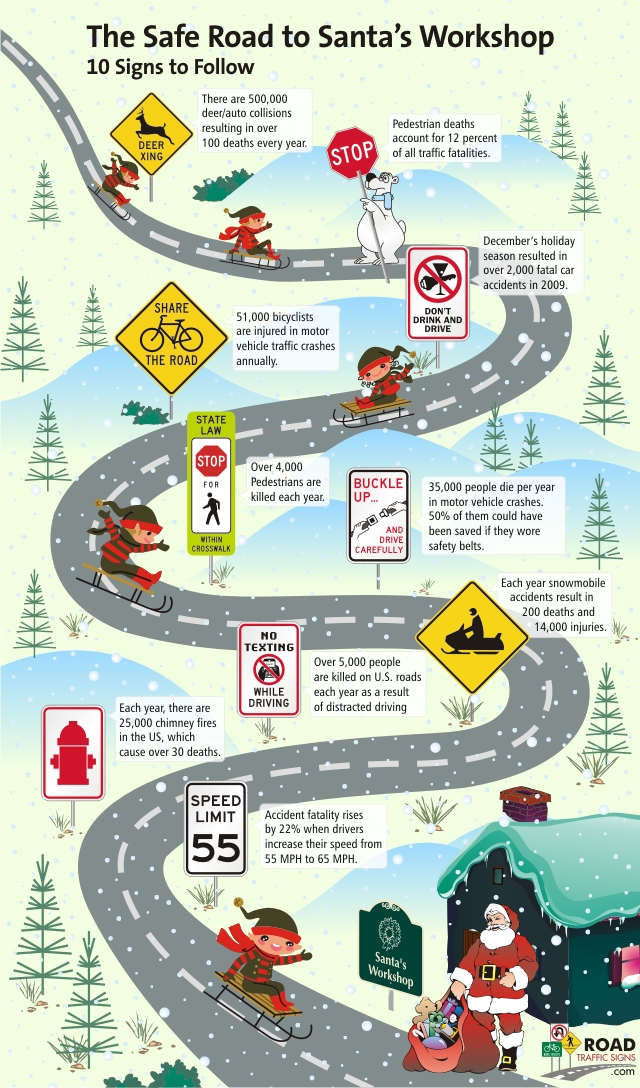
Cheer is in the air as the holiday season approaches. Just don't overlook increased risks of being out on the road! As you head to Aunt Judy's Christmas dinner or Bob's Ugly Sweater Party, it is increasingly important to drive safely.
This time around, take a safe trip with Santa's elves as they follow the cement road to his workshop. You'll learn how (and why!) to stay away from dangerous driving practices, and hopefully keep these facts and more in mind while you're behind the wheel this holiday season. Here are just a few statistics from the infographic:
- 17,000 people die per year in the U.S. in motor vehicle accidents because they weren't wearing a seat belt.
- In December 2009 alone there were 2,387 fatal crashes.
- Pedestrian deaths account for 12 percent of all traffic fatalities.
Sure, these facts are serious, but don't think of RoadTrafficSigns as the Christmas Grinch. Turn to these signs as a support system to help you drive safe this holiday season. Cheers, from RoadTrafficSigns.com.
Labels: driver safety, holiday driving, road rules and road signs
Monday, October 31, 2011
Driving In Snow and Ice

It's just around the corner; winter is on the way and, if the past couple of winters are any indication, people as far south as central Georgia and Alabama, where snow is a rarity, could be looking at record snow and ice storms. That means a lot of drivers, who may have never driven in the snow, could be could be surprised by snow and ice while they are out on the road.
For someone who has never driven in snow and ice, conditions on the road can be deceiving. A light dusting of snow can be treacherous and it can hide a layer of ice below. Novice drivers often find themselves spinning out of control because they failed to fully appreciate how slippery a small amount of snow fall can be. Here are some of the issues to be aware of:
- Bridges - When temperatures start to fall below zero, the first areas on the road to freeze will be bridges and over-passes. While the ground under a road surface will stay warm for a while, the frigid air is circulating both above and below the bridge surface dropping the temperature of the bridge surface rapidly. Even a small amount of moisture on the road can turn into almost invisible patches of ice on bridges and over-passes.
- Traction - You must drive slower; your tires will not have the same grip that they would on dry roads. Most state driver's manuals provide the following guidelines for driving in bad weather:
- Wet road: Slow down 5 to 10 mph.
- Packed snow: Slow down to half speed.
- Ice: Slow to a crawl.
If you do start to skid and can't regain control of the car, try to find something to stop you. Try to get a wheel on dry pavement or on the shoulder of the road, or slowly edge into a snow bank or some bushes. - Visibility - Falling snow can make it difficult for you to see other vehicles and for them to see you. Treat snow just like fog; turn on your low-beam headlights (high beams will reflect off the snow and make it more difficult to see) and slow down.
Before driving make sure you completely clean the snow off of all of your windows and lights. Many states also require that you remove accumulated snow and ice off the surfaces of your car to keep them from flying back and blinding the driver or damaging the vehicle behind you.
If you expect snow or ice overnight, lift your windshield wipers away from your windshield to keep the rubber from freezing to the glass surface. - Watch for Other Drivers – Other drivers who either don’t know how to drive in snow and ice, or who think they can control their vehicle in spite of the road conditions can present a danger to other drivers on the road. If you see a driver like that approaching you, try to get out of the way and let them pass.
The National Safety Commission recommends The Driver Education Handbook for Parents as a valuable teaching tool for parents who are concerned with their teen's driving safety and understand the value of quality instruction.
Labels: driver safety, ice and snow, road safety, winter driving, winter weather
Tuesday, September 27, 2011
Drive Safely Work Week, October 3-7, 2011
In these difficult economic times, employers who are looking for ways to cut costs may be overlooking a large savings that can be achieved rather easily and at a very low cost. That cost cutting method can be achieved through the institution of corporate driving safety policies and by educating not only employees but their families as well on the importance of driving safety.
No matter how dangerous the occupation, the most dangerous part of the day for any employee is the time spent behind the wheel, whether commuting to and from work or while driving as a part of their work duties. Traffic collisions after work hours by the employee or their family members also cost the employer in lost productivity and benefit costs.
The Network of Employees for Traffic Safety (NETS) has designated the week of October 3-7, 2011 as Drive Safely Work Week to educate employers and employees on the importance of driving safety. The NETS website contains a wealth of information for employers on the costs of traffic collisions and methods the employer can use to reduce traffic collisions by their employees and benefit-eligible dependents.
According to the NETS website's "10 Facts Every Employer Must Know," "In 2000, the economic cost of crashes to employers was $60 billion resulting in 3 million lost workdays. Two-thirds of the cost ($40 billion) was from on-the-job crashes while one-third ($20 billion) was from off-the-job crashes for employees and their benefit-eligible dependents.”
"The average on-the-job crash costs an employer about $16,500 or just under $0.16 per mile driven. Crashes involving injuries cost substantially more — $504,408 for a fatal injury and $73,750 for a nonfatal injury.”
"Damages awarded to plaintiff’s making negligence claims against companies are at an all time high, settlements of $1 million or more are not unusual."
The focus of 2011's Drive Safely Work Week, called "Focus 360" is on distracted driving. Distracted driving has been recognized over the past several years as one of the major safety issues on America's roads. The transformation of cell phones into mini-wireless computers has become the number one distracting force on the road and has led to a shockingly high number of collisions, injuries, and deaths. Add to that all of the other distracting activities that a driver can engage in and it is a wonder anyone is watching the road at all. A study by the Virginia Tech Traffic Safety Institute shows the following:
| Behavior | Increased Crash Risk |
| Texting | 23 Times |
| Reaching for a Moving Object | 9 Times |
| Dialing a Cell Phone | 6 Times |
| Driving Drowsy | 4 Times |
| Looking at an External Object | 3.7 Times |
| Reading | 3.4 Times |
| Talking on a Cell Phone | 4 Times |
| Applying Makeup | 3 Times |
If your company does not have a policy on distracted driving and cell phone use, you are encouraged to create one and vigorously enforce it.
Other steps that employers can take to institute their safe driving policies are to encourage their employees and their family members to attend driver training. Driver training classes, either online or in a classroom, can provide needed refresher training for employees and help them to refocus on what is really important behind the wheel. Providing such training can result in lower insurance costs for both the employer and the employee.
Labels: avoid distracted driving, drive safely work week, driver safety, driving drowsy, drowsy driving, traffic safety
Wednesday, September 21, 2011
Five Most Dangerous Cities For Pedestrians

Transportation America, a coalition of housing, business, environmental, public health, transportation, equitable development, and other organizations, has published a report on the dangers faced by pedestrians in the US. According to the study, while motor vehicle fatalities have gone down over the last several years, pedestrian death rates have fallen only marginally and, in some of the most dangerous cities, have actually risen.
Transportation America attributes the decrease in motor vehicle deaths to stronger laws, greater seat belt use, and efforts to reduce drunken and distracted driving but, according to the study, pedestrian safety has received very little attention from traffic safety and transportations experts at the state and federal level.
The study states that steps are not being taken to provide sidewalks and other safety measures for pedestrian traffic. According to the report, pedestrians make up nearly 12 percent of total traffic deaths. The study's authors state; "These deaths typically are labeled "accidents," and attributed to error on the part of motorist or pedestrian. In fact, however, the majority of these deaths share a common thread: they occurred along "arterial" roadways that were dangerous by design, streets engineered for speeding traffic with little or no provision for people on foot, in wheelchairs or on bicycles."
Using data on pedestrian deaths over the previous ten years and census data on walking, the study's authors created a Pedestrian Danger Index (PDI) to rank America's cities according to their risk to walkers.
The results are bad news for Florida. Four out of the top five most dangerous cities for pedestrians are in Florida. The cities ranked by their PDI are:

Please CLICK on image for details.
In Florida in 2009, more pedestrians were killed (466) than passengers in motor vehicles (453).

Remember, pedestrians in crosswalks always have the right-of-way. Even if you have the green light, you must wait for pedestrians to clear the crosswalk.
Be on the lookout for motorized wheelchairs on the road. With no sidewalks, a person in a wheelchair has nowhere else to go.
Blind pedestrians with a white cane or a guide dog always have the right-of-way. All traffic in both directions must stop when a blind person is crossing the road.
When driving, be on the lookout for pedestrians, especially around shopping areas, schools, and playgrounds. Don't assume that, because the pedestrian looks at you, that they won't step out into the road. The pedestrian may be assuming that you will stop.
Labels: crosswalk, driver safety, pedestrian right-of-way, pedestrian safety, right-of-way, traffic safety
Friday, September 16, 2011
Top Five Safest Cities For Driving In America
Labels: driver safety, traffic collision, traffic crashes, traffic safety
Thursday, September 15, 2011
Top Five Most Dangerous Cities For Driving In America
The list shows a driver’s likelihood to be involved in a collision and the average number of years a driver in that city can expect to go between collisions. Based on their results, the most dangerous cities in America for drivers, in terms of ranking, are:
1. Washington, DC – A driver in Washington can expect only 4.8 years between collisions and the chances for being involved in a collision are 107.3 percent more than the national average.
2. Baltimore, Maryland - A driver in Baltimore can expect only 5.3 years between collisions and the chances for being involved in a collision are 88.7 percent more than the national average.
3. Glendale, California - A driver in Glendale can expect only 5.5 years between collisions and the chances for being involved in a collision are 80.8percent more than the national average.
4. Newark, New Jersey - A driver in Newark can expect only 5.9 years between collisions and the chances for being involved in a collision are 70.8 percent more than the national average.
5. Providence, Rhode Island - A driver in Providence can expect only 6.0 years between collisions and the chances for being involved in a collision are 66.7 percent more than the national average.
The complete Allstate report can be seen at: http://allstatenewsroom.com/releases/00c90674-c797-4dd0-82c8-3813ccbe1e1e:en-US/download/e3fc06ab-a016-4248-89ef-72454729bd0a
Labels: driver safety, traffic collision, traffic safety
Wednesday, August 10, 2011
Are Your Headlights Getting Dimmer?
Over the past ten years or so, headlights started to change. Older drivers may remember when it came time to change the headlights, having to get a large headlight fitting that included a new glass lens. Nowadays, when it comes time for a change, you just swap out the bulb by itself. It is much cheaper and there is no longer any need to adjust the headlights so that they are aimed properly.
The problem with this new system though is that the lens doesn't get changed and, over time, it tends to get scratched up and very dirty. It's not the bulb that is growing dim; it's the scratched and cloudy lens that is making it hard for the light to penetrate through. To correct the problem, you need to clean the lens. Cleaning the lens however isn’t as easy as running some soap and water over it. You need to remove the scratches that are holding the dirt.
There are several products on the market designed for cleaning headlight lenses. Most of these products are easily available at auto parts or big box department stores and they don’t cost much. Some are rub-on, rub-off type products similar to car wax in their application. Some products include a small buffer that can be used with an electric drill to polish the lens. All promise ease of use but some are easier than others. You'll have to experiment to see which one is best for you. Regardless of the type you use, the chore doesn’t take long and the results can be dramatic.
Remember, that driving safety rules say you should never drive so fast that you "over-drive your headlights". In other words, you need to be able to stop within the distance covered by your headlights. As your headlights become scratched and cloudy, that distance becomes shorter and shorter. Don't take a chance on over-driving your headlights; clean your lenses. You’ll be pleased with the results.
Labels: driver safety, headlights, thanksgiving traffic safety, vehicle safety
Wednesday, June 29, 2011
4th of July Road Trip Safety Tips 2011
This year, the fourth is on a Monday, which would signify a long weekend. As such, it is highly advised to be on the lookout as early as now, as some people extend their holidays by taking time off work early to hit the road.
Here are a couple of Fourth of July Road Trip Safety Tips to minimize the hassle and maximize enjoyment for you and your family:
- Check your car. Are your tires worn-out or do they have the enough tire pressure? Does your battery have enough juice to last the whole trip? Are your lights in proper working order? Sometimes, it's easy to overlook such things when everyone is hectic in packing up for a fun getaway. Making sure that your vehicle is properly maintained will help lessen your chances of being stuck in traffic or worse, stuck in the middle of nowhere.
- Forget the fireworks. The Fourth of July is synonymous to blowing stuff up and lighting the sky. This time around, why not just forget it? There will be enough fireworks displays all around, so by just watching, you lessen the harm fireworks may bring to you or your family. Also, it is important to note that in some parts of the country, fireworks are downright illegal. Getting caught with them in your vehicle might just end your road trip. If you really must, familiarize yourself with the fireworks policies of your destination, and keep them away from small children.
- Plan ahead. Find out if there are events or activities in your destination beforehand. This will help you plan your time and possibly avoid areas where there will be a large volume of vehicles.
- Always park in covered areas. Remember this especially if you will be going to a place where there will be fireworks displays. Firework debris falling from the sky may harm you or your family, or damage your vehicle.
- Keep food cool. If you are planning on having a barbeque, remember that the quality of food should be as important as the quality of your driving safety! If you will be using coolers, keep them out of direct sunlight and avoid opening them every so often. Keep food cool, especially meat and poultry and only pop them out when they're ready to grill. Use a different cooler for beverages and perishables. Most important of all: always clean up after you're done.
Have a fun and safe Independence Day!
Labels: driver safety, holiday, holiday driving
Tuesday, December 21, 2010
Decembers is National Drunk and Drugged Driving Prevention Month
With the festivities, events and parties that people are bound to attend this month, there can be no better month to be chosen to educate drivers about safety, beginning at the start of the month, and ending just before the new year. Here are some facts about impaired driving due to illegal substance consumption:
- 1 in 3 fatal vehicular crashes involve an alcohol/drug-impaired driver.
- The highest rate of impaired drivers is young adults aged between 18 and 25.
- Even after the consumption of just 1 drink, decision-making abilities become impaired and drivers begin to lose their inhibitions. After 2 drinks, reasoning and memory are affected.
- 3 out of 10 Americans face the possibility of being directly involved in alcohol/drug-related traffic accident during their lifetime.
- Each year, alcohol-related crashes in the United States cost about $51 billion. (2002)
What can be done? Here are just some suggestions on how to avoid becoming part of the grim statistics:
- Plan ahead. Figure out a way to get home/be taken home in case there will be drinks in a party.
- Better yet, leave your car and don't get behind the wheel at all --- have a designated driver, find information about designated driver services, grab a cab or ask to stay over if the party is at a friend's house.
- Don't let friends drive drunk. Find ways to get keys from a friend if that friend has any alcohol intake. They may get annoyed, but it's all for their own good.
Most driving safety organization support the drunk or drugged driving prevention program or campaign informing drivers via education. This year's focus for National Drunk and Drugged Driving (3D) Prevention Month is on getting the message across for the younger drivers, in order to keep them safe.
Public awareness coupled with highly-visible law enforcement campaigns will help drivers celebrate the holiday month, and not have to worry about being a statistic.
Labels: alcohol, designated driver, designated driving service, driver safety, driving under the influence, drugged driving, drunk driving, dui, National Drunk and Drugged Driving, prevent drunk driving
Monday, November 15, 2010
Tire Safety Tips

Should tires have an expiration date?
This is a question being asked by some of the traffic safety organizations. Right now there is a system in place that includes just the date of manufacture. The newest reports tell you to be sure to check the dates on each tire and that they recommend that a tire be no more than 10 years old. Although, there are some car makers that suggest that tires not be used after 6 years. There is a date that appears on the tire, it usually has 4 numbers, the first two numbers show the week that it was made, and the next two the year of manufacture. (Example – 1510 – would be April 2010 or the 15th week of 2010). When older tires are used they can split open, cause a blowout, not hold the road during bad weather, and cause a skid. Although your car might have many other safety features, tires can control your comfort and safety so make sure they are in good condition and they will take care of everyone in the car.
Tire pressure should be checked once a month and before every long trip. Under inflation of tires affect the handling of your vehicle as well as fuel consumption. It can cause structural failure, uneven tread on the outer edges of the tire and possible tread separation. Look for wear, damage cracks or bulges, punctures, nails or an object that becomes imbedded in the tire. Also, loss of pressure can come from the valve stems. All of these can make your tires look low or flat.
The use of nitrogen to fill the tires instead of just air has some advantages. Although, there is a cost factor involved because many of the tire stores do charge extra to remove the air and put in nitrogen. The advantages of having nitrogen include having a more constant tire pressure and eliminating any moisture that could build up and cause damage to the wheels, possibly giving you a little better mileage and preserving your tires a little longer.
If a tire needs to be repaired, external plugs should not be used. If a plug is necessary it should be an inside plug. Other factors to keep tires in good condition are having them balanced, alignment to prevent uneven wear, rotate when you change your oil or about every 6000 miles, never overload or overheat the tires, put the correct size tires on your auto and replace them when needed.
Of course, always think of SAFETY FIRST!
Labels: driver safety, tire safety, vehicle inspections, vehicle safey
Friday, October 08, 2010
Driving Survival: How to Survive a Vehicle Emergency
After a driver or passenger has been involved in a collision, disorientation, confusion, and possibly panic, are normal human reactions. In this series of articles on how to survive various emergency situations, we want to give the driver some good, common sense advice in the hope that, instead of panicking, a driver will recall the information and act correctly to get out of a dangerous situation. Even though the chances of any of these events happening to you are rare, knowing what to do in advance can prevent panic and help you cope with a bad situation.
Safety Tip Number One
Regardless of the crash situation you may find yourself in, your chances of survival increase by up to 55% if you are wearing your seatbelt. You are always safer, confined within the vehicle than you would be if you were ejected out the window or tossed around in the vehicle as it reacts to a major crash. Seat belts are always survival tip number one!
Safety Tip Number Two
Don't Panic! Panic is the enemy in any survival situation. Panic can lead to bad choices. Try to remain calm, take stock of your surroundings and the situation you are in. After surviving a car crash, the first thing you will want to do is exit the scene and remove you and your passengers away from a possible secondary collision situation. Panic will make that escape much more difficult.
Air Bags
When airbags deploy in a collision, the first thought many people have is that the car is on fire. While always possible, the chances of a vehicle catching fire, due to the collision, are rare. There are two reasons why people think that the car is on fire after the airbags deploy. The folds of an airbag are coated with talcum powder to keep the rubberized fabric from sticking to itself in long term storage and to ensure a smooth deployment. Once the airbag deploys, the interior of the car is filled with talcum powder. When the airbags deploy, a small explosive charge ignites two chemicals and that react to form the nitrogen that is used to fill the airbag. The smell of that chemical reaction is unfamiliar to most and that, combined with the talcum powder filling the car’s interior, is the reason why many people think the car is on fire. That isn’t the case. If the car is truly on fire, the smoke will most likely be dark and oily.

Airbags are terrific lifesaving devices but remember, they won’t deploy unless the sensor takes a direct hit. Also, because airbags are only effective if people wear their seat belts, the airbag may not work if the seat belt isn’t securely fastened.
After the airbags deploy, they will deflate one second later to make escaping from the car easier.
Window Punch
If, for any reason, you find yourself trapped inside a vehicle and you are unable to open the doors, or windows, you may find it very difficult to smash the windows from inside. The tempered glass used in car windows is very strong and difficult to break. There is a cheap spring loaded punch, sold in most auto parts stores for less than $10 that is designed to quickly shatter the window. Auto windows are designed to shatter into thousands of small, relatively smooth shards so the chances of being cut are minimal but you will want to shield your eyes before breaking the glass.
Keep the window punch handy and close to the driver’s position but make sure it is secure. Leaving it out on the dash will just allow it to fly around the car in a crash and you won’t be able to find it when you need it.
Get Away from the Vehicle
Once you have escaped the vehicle, you will want to place you and your passengers well off the roadway. The chances of another, secondary crash are very real so you need to stay as far away as you can until help arrives.
Next in the Series: How to Survive a Rollover
Labels: air bags, driver safety, emergency, emergency vehicle
Tuesday, October 05, 2010
Staying Safe at Railroad Crossings
Because your life, and the lives of others, depends on your skills as a driver, the following are some suggestions for you to think about when approaching highway/rail grade crossings:
- Trains do not run on set schedules and can be anywhere, on any track, at any time, going in any direction.
- Always yield the right of way to the train because the engineer cannot yield to you. Remember, it takes the average fully loaded freight train 1 mile to come to a stop.
- Never ignore active warnings at crossings. Locomotives are huge; 17 feet high and 10 feet wide. As a result, they appear to be traveling much slower than we think when viewed from a slight angle at the crossing. The combination of size and angle create an illusion and fool our minds into thinking the train is farther away than it actually is.
- Trains will arrive at a crossing faster than you expect. One in four highway-rail crossings takes place when drivers run into the side of the train. Often it's because the driver is going too fast for conditions such as darkness, rainy weather or fog.
- Always remember to look and listen when you see advance-warning signs indicating a rail-highway crossing.
- Never pass another vehicle when approaching a railroad crossing
- Before starting across the tracks, be sure there’s room to get across completely
- If driving a "stick-shift," be sure to shift well ahead of or after the railroad crossing to avoid getting stuck on the tracks.
- If your vehicle is ever stalled or trapped on the tracks and a train is approaching, quickly get yourself and all other passengers out. Don't try to take any other items with you. When the train strikes the vehicle it will send flying metal and glass ahead and outward from the locomotive. This is why it is extremely important that you and your passengers run far enough away from the tracks and in the direction of the oncoming train so you will not be hit by flying debris.
When it comes to railroad crossings, it is your responsibility to avoid a train since it cannot avoid you. Always keep in mind that any time is train time. Remember to look, listen and live. Stopping may add 60 seconds to your journey while not stopping could put an end to it completely.
Labels: driver safety, railroad, railroad crossing safety, trains
Monday, July 12, 2010
Safety Tips for Driving During 2010 Hurricane Season

We are well into the 2010 Atlantic hurricane season and have already experienced one hurricane in the western Gulf of Mexico. Based on predictions from the National Oceanic and Atmospheric Administration (NOAA), this season has a high probability of above normal activity and NOAA is predicting:
- 14-23 Named Storms,
- 8-14 Hurricanes
- 3-7 Major Hurricanes
The late summer months traditionally see the greatest amount of hurricane activity so it's a good idea for residents of the Atlantic and Gulf coasts to prepare now and consider what needs to be done, especially in regard to remaining safe on the road in the event of an evacuation.
Plan ahead - Fortunately, unlike other natural disasters, hurricanes give us plenty of advanced warning. When planning for an evacuation you should:
- Gather important papers such as homeowner's insurance policies and other documents that you can’t afford to lose.
- Make sure the vehicle you plan to take is in good mechanical condition. Keep oil changes up to date and make sure the fluid levels are topped off.
- Make sure your tires are in good condition. You will be driving on rain soaked roads and excessively worn tires could make driving conditions treacherous.
- Ensure you have a full tank of gas and, as the hurricane approaches, top it off. Gas stations may quickly run out of gas as the hurricane nears.
- Make sure you have some cash available. Power may be knocked out to your bank and debit cards may be difficult to use.
- Plan your evacuation destination. Inland hotels will fill up quickly and you may not be able to get a room without a prior reservation. Many hotels may not allow pets.
Evacuate Sooner rather than later – Driving conditions will be dangerous and the roads will be packed. In 2004, Hurricane Jeanne, a storm that only reached category 2 status, made landfall in south Florida but downed trees and caused flooding and massive power outages in NE Florida almost 200 miles away.
- As the high winds approach, bridges and causeways leading inland may be closed.
- Major interstates and highways will be closed to incoming traffic and all lanes will be open to outgoing traffic only.
- Power outages will effect traffic lights causing further delays.
- Obey the orders of law enforcement and National Guard personnel. Their directions carry the force of law.
- Tune your radio to those stations that carry the Emergency Broadcast System and listen for reports.
Exercise patience and caution while driving – Be especially watchful of other drivers and road conditions.
- Understand that the roadways will be packed with evacuees and driving conditions will be very slow. Don’t allow your temper to get in the way of safe driving behaviors.
- Hurricanes spawn tornadoes. If a tornado approaches, get out of your car and seek shelter in a substantial building or in a low-lying area such as a ditch or culvert.
- Watch out for flooded roads. If the road ahead is flooded, turn around and find an alternate route.
- Flooded roads may hide the fact that the roadway is washed out underneath.
- The roadway could collapse under the weight of your vehicle.
- As little as six inches of rushing water can force your car off the road.
If you can, avoid coming back home until the roadways have been cleared and power is restored. For more information on hurricane preparedness visit:
Additional Safety Tips for: Hurricane Seasons and Flooded Roads
Labels: driver safety, hurricane preparedness, hurricane safety, hurricane season
Thursday, July 01, 2010
Keeping the 4th of July Safe and Fun
Though the fourth is still on Sunday, AAA suggests that motorists be extra-careful starting today until Monday, as most folks extend their weekend celebrations, and there is a high possibility of roads being heavily congested as early as Thursday.
Here are a couple of driving safety tips for you and your family to enjoy this great holiday:
Plan ahead, be patient. - Decide where you want to go this weekend, map out routes and alternate routes to experience less time on the road. Chances are, other people are going to be traveling too. So places like parks, beaches and other summer spots are bound to be packed. The best way to get to any of them is spending less time on the road driving.
Know the schedule of events in your area. - Find out if your local community has plans for gatherings in your area, plan your driving schedule around them to avoid driving and finding yourself stuck until a street parade/party is over.
Park in covered areas. - If you're planning on attending any parades or fireworks displays, park in a covered area. Firework debris falling from the sky may damage your vehicle and cause harm to your family.
Consider having a barbeque at home and invite friends instead. - A great idea of celebrating the fourth of July is having a barbeque or picnic in the backyard and inviting your friends instead.
Read More: Safety Summer Driving Tips for the Fourth of July.
National Highway Traffic Safety Administration - Impaired Driving Prevention Campaign (June 20 - July 4, 2010)
Labels: driver safety, driver safety tips, fourth of july
Thursday, June 24, 2010
Driver Safety for the Most Dangerous Highways in Florida
Which tells us two things:
1.) accidents on these Florida roads are most likely caused by people who aren't familiar with the road, namely, tourists, and
2.) summer is a key factor to these accidents, as most happen during summertime, when thousands of tourists are going on roadtrips to Florida, driving in unfamiliar roads and being potential risks to traffic safety.
Here are three of the most dangerous roads in Florida today, some facts about them and how to keep safe while driving on them.
Interstate-95 – Being the longest north-south Interstate Highway in America, I-95 passes through 15 states in its length. It connects to several states such as Georgia, North and South Carolina, Virginia, Pennsylvania, New Jersey, New York, Connecticut and Massachusetts. Parts of the road carries at least 250,000 cars every day, on a normal day. Imagine if tourists were added to that number. The problem lies in not knowing the proper merging areas and exits on this road. A car might try to back down from the wrong exit and that might cause accidents. Also, there are parts of this road that are long stretches to drive on, making some new drivers feel comfortable in trying to speed through them. There are speed limits to this road, and following them will keep a driver safe. Also, mapping out on a GPS exactly which exits to take can make for a safer ride through I-95.
Interstate-4 – I-4, the way to most of Florida's theme parks, including Disney World and Universal Studios is the one bound to be the most accident-prone for tourists. As residents drive too fast, tourists are driving too slow, trying to figure out how to get to where they are going. Hotspots here to consider are the Maui curve, where drivers drive too fast and flip over and Kirkman road, where tourists usually can't figure out which way to go (right or left).
Interstate-75 – With major constructions currently ongoing on I-75, every turn has the potential for danger. The kicker is, lane shutdowns also happen after accidents. I-75 provides routes to Jacksonville, Tallahassee, Alabama and Georgia, among other places, and potholes on the road may go by unseen and cause accidents. Having full attention to the road while driving on the I-75 may provide increased safety.
Thousands of drivers go through these roads on a daily basis and each come home without an accident. Knowing the way to go and exits is a big plus, while maintaining full attention to driving and speed limits adds to safety.
Have a fun summer, and be careful of these roads!
Other related articles: Driver safety tips for a Safe Fourth of July weekend.
Labels: crash avoidance, driver safety, driver safety tips, highway, Highway Safety, safety, safety tips, vehicle crash, vehicle safety
Tuesday, June 15, 2010
Skidding vs. Hydroplaning (Neither One a Good Option)

The spring/summer rainy season has started in some parts of the country and the summer thunderstorm season is near. With the rains come hazardous driving situations in the form of skidding and hydroplaning. Skidding and hydroplaning are two separate hazards but each has the same result and drivers who react instinctively could be headed for trouble while drivers, who have a plan in mind, can act correctly to avoid disaster.
Skidding – Skidding occurs due to slick conditions on the road whether it be rain, snow, sleet, or ice. While people tend to be more cautious when driving on snow and ice, they don’t seem to show the same caution when driving in the rain and that can have disastrous results. In the periods between rainfalls, oil and grease build up on the roads and the warm sun keeps the oil and grease in a liquid state. The most dangerous time for slick roads in rain is shortly after the rain begins and there is a thin layer of water on the roads. Once it starts to rain, the oil and grease float on top of the water creating a very slick surface. The roads are at their slipperiest within the first half hour after it starts to rain. Eventually, the oil and grease will be washed down the drains and the roads will lose that slick coating of oil but that is not the time to relax because, as the rains increase, the conditions for hydroplaning increase.
Hydroplaning – Hydroplaning occurs when there is standing water on the road and the depth is such that the car’s tires can’t squeeze the water out between the tire’s treads. If this happens, the tires will ride up on top of the water like a pair of water skis and lose all contact with the road. This can occur at speeds as low as 35 mph and becomes most dangerous at 55 mph or more.
Skid prevention – There are several things to keep in mind to prevent skidding or hydroplaning:
Tires – Few people realize that tires are the most important control device on your car. The steering wheel and brakes aren’t much good when the tires aren’t in contact with the road. Tires need to be kept in good condition and checked often for tread wear. There should be a minimum of 2/32 of an inch of tread depth on your tires. A simple way to check the depth is by sticking a penny between the treads. If the top of Abe’s head is visible, your treads are too thin and your tires should be replaced.
Brakes – Drivers need to be aware of the type of brakes they have on their car. There is a huge difference between standard brakes and anti-lock brakes when it comes to dealing with a skid.
- Standard brakes are not designed to stop your car in skidding conditions. When you lock up standard brakes, you are no longer able to steer the car. If you slam on standard brakes you are just going to make things worse and you could cause the car to careen out of control. If your car is equipped with standard brakes, DO NOT APPLY THE BRAKES until you have regained control of steering and your car has started to slow down on its own.
- Anti-lock brakes (ABS) are designed to prevent losing control of the car in a skid situation. They do this through use of a computer that detects when a tire is turning faster (trying to grip the surface) and applying pressure independently to each individual brake up to 20 times a second. This allows you to slow the vehicle while still being able to steer to avoid a collision. With the brakes pulsing that rapidly, the driver will feel a fluttering in the brake pedal. Unfortunately, many drivers, who are unfamiliar with ABS, feel this and think something is wrong and take their foot off the brakes. That is a big mistake! When applying anti-lock brakes in a skidding situation, you should expect to feel the brakes fluttering under your foot and understand that the system is operating correctly.
Cruise Control – Cruise control is a great system to prevent speeding (and getting a ticket) and to increase your gas mileage. However, you should NEVER USE CRUISE CONTROL IN THE RAIN! If your tires start to spin, the cruise control will detect this and will try to correct it by increasing the speed. That is the last thing you want to have happen in a skidding situation.
Recovering from a skid – Whether you are skidding on slick streets in light rain or hydroplaning through deep standing water, the method of recovery will be the same. If you feel your car start to skid:
Take your foot off the gas! Again, you shouldn’t be using cruise control.
If your car is equipped with standard brakes, do not apply the brakes. If you were applying the brakes when you started to skid, take your foot off the brakes.
If your car is equipped with ABS, apply firm pressure to the brakes. You will still maintain control of steering while the brakes are applied.
Steer the car in the direction of the skid. In other words, if the rear of your car is skidding to the left, turn your wheel to the left. Try not to look at the hazards but instead, look at where you want to steer the car and keep steering in that direction until you have regained control of the car.
Once you have regained full control of steering and the car has slowed on its own, you may be able to apply standard brakes effectively to bring your car to a stop.
Here are a few additional tips for Driving in the Rain and Sleet.
Labels: driver education, driver safety, flood roads, flood waters, hazardous roads, hydroplaning
Monday, June 14, 2010
Safety Tips for Hurricane Season and Flooded Roads

The start of June may mean many things to many people, like prom and graduation for teens, or the start of vacation, but it is also known as the start of hurricane season. Hurricanes, as we all know, cause strong winds and heavy rains, which may lead to flooding. In case of floods and hurricanes, preparedness and patience go hand-in-hand for survival.
Here are a set of guidelines when facing a hurricane/flood:
Stay tuned – Natural disasters like these are usually the time to fire up the radio. If it hasn't rained yet, or there are no warnings in your area, stay updated by listening to the radio.
Specifically, a radio that is battery operated and doesn't need to be plugged in. During heavy rain and strong winds, it is a good idea to turn off the power in your home, so a battery/crank-operated radio will be your lifeline to the situation.
Stock up – If you're one of those families who stock up groceries every week, find out what other supplies are needed. These might include: clean water, medicine, candles and batteries. Make sure the food supply will last for the family for a couple of days, supposing you'd be staying at home.
Check your house – Make sure that there are no damages to the house that might compromise its structural integrity during heavy winds. A cracked window may make for a potential accident waiting to happen. Keep away from windows during a hurricane. Turn off the power if there's a potential for flooding in the home. If you'll be staying in the house, it's a good idea to keep away from electrical equipment, as they pose threats for lightning.
If you need to drive – If there is an absolute need to drive, consider first the importance of driving. If it's to survey the surroundings, then don't. Next, consider the weight of the car. The lightest of cars are usually the first ones to lose control on the road. Make sure the gas tank is full, the engine is well-maintained and that the tires still have enough traction to keep on the road. As little as an inch of water is capable of making a vehicle lose control, so if you have to drive, slow down. If you have to drive for supplies, there's no need to bring the whole family along. If the family needs to evacuate, know the exact roads you'll be traveling in, bring cash that will last for several days and bring cell phones. Keep the phones in a higher part of the car, so as to avoid flood damage.
After the storm – There are typically more casualties after a hurricane than during one. Stay indoors until the news updates say that it is all clear. Do not attempt to use electrical equipment. Do not wander around. Keep away from fallen wires and puddles near them. Survey the damage in the house (if any) and find out what needs to be fixed/done to make sure that you and your family is a little safer.
To help you prepare for this season read more about how to deal with flooded roads.
Labels: driver safety, driving safety, flood waters, flooded roads, hurricane preparedness, hurricane safety

 Find us on Facebook